
Which Electrical Upgrades Should Older Homes Get First?

Last Updated: November 2, 2026
Quick Summary
The most important electrical upgrades for an older home are usually a panel replacement, outdated wiring and grounding repairs, GFCI and AFCI protection, LED lighting, and planning for new loads like EV chargers. Start with safety items such as panel condition and grounding, then move to lighting and new loads. A licensed electrician should evaluate your home first.
Warning signs include dimming lights, frequently tripped breakers, and warm or buzzing outlets.
Check for fuse boxes, split-bus panels, or Federal Pacific and Zinsco breakers.
Service capacity, breaker space, and branch-circuit requirements are separate factors to check.
Identify knob-and-tube, aluminum, or cloth-insulated wiring and two-prong outlets with no ground.
Plan upgrades in order: safety items first, then lighting and new loads like EV chargers.
Table of Contents
How to Tell Whether Your Older Home Needs Electrical Work
Older homes often carry electrical systems that were built for a much smaller load than today's appliances, chargers and electronics demand. If your lights flicker, breakers trip, or outlets feel warm, your home may be telling you it is time for electrical upgrades. A licensed electrician can walk you through these warning signs before any work begins.
Look for these common signals:
Lights that dim when a large appliance starts
Breakers that trip often, especially on the same circuit
Outlets that feel warm, buzz, or smell like burning plastic
Two-prong outlets with no ground, or a lot of extension cords in use
A panel that is a fuse box, or a breaker panel with a brand you do not recognize
Any of these signs deserves a professional look. Our electrical troubleshooting service is one place to start if you want a professional to find the cause.
1. Replace an Aging Fuse Box or Overloaded Panel
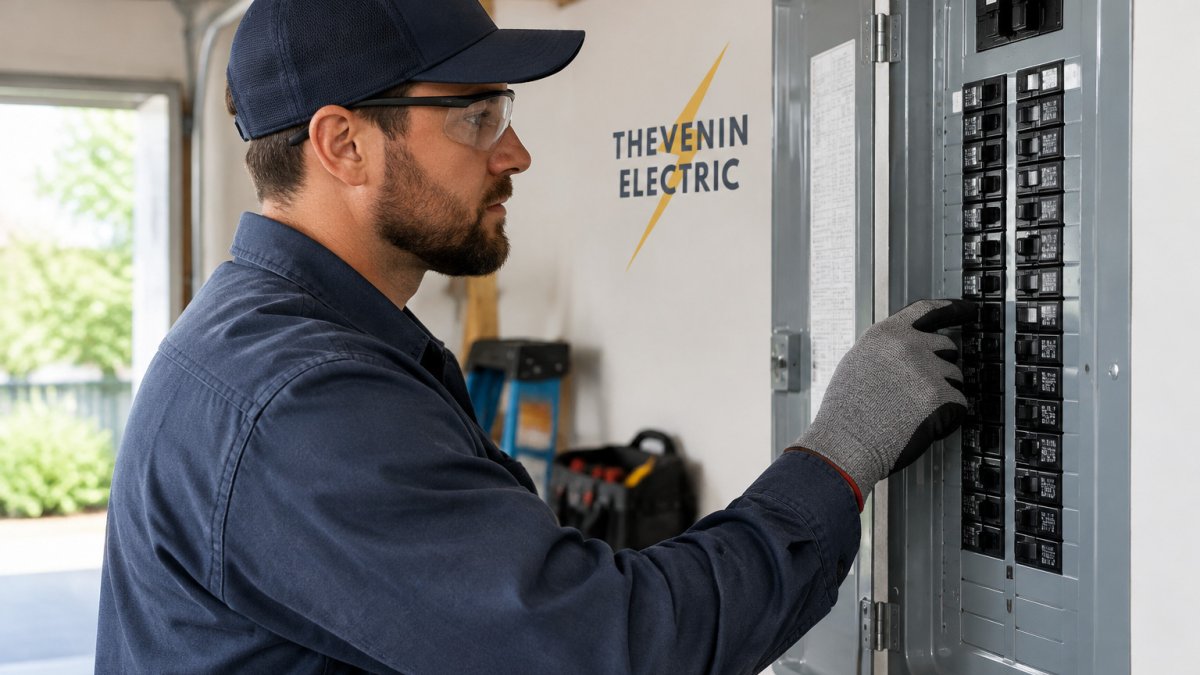
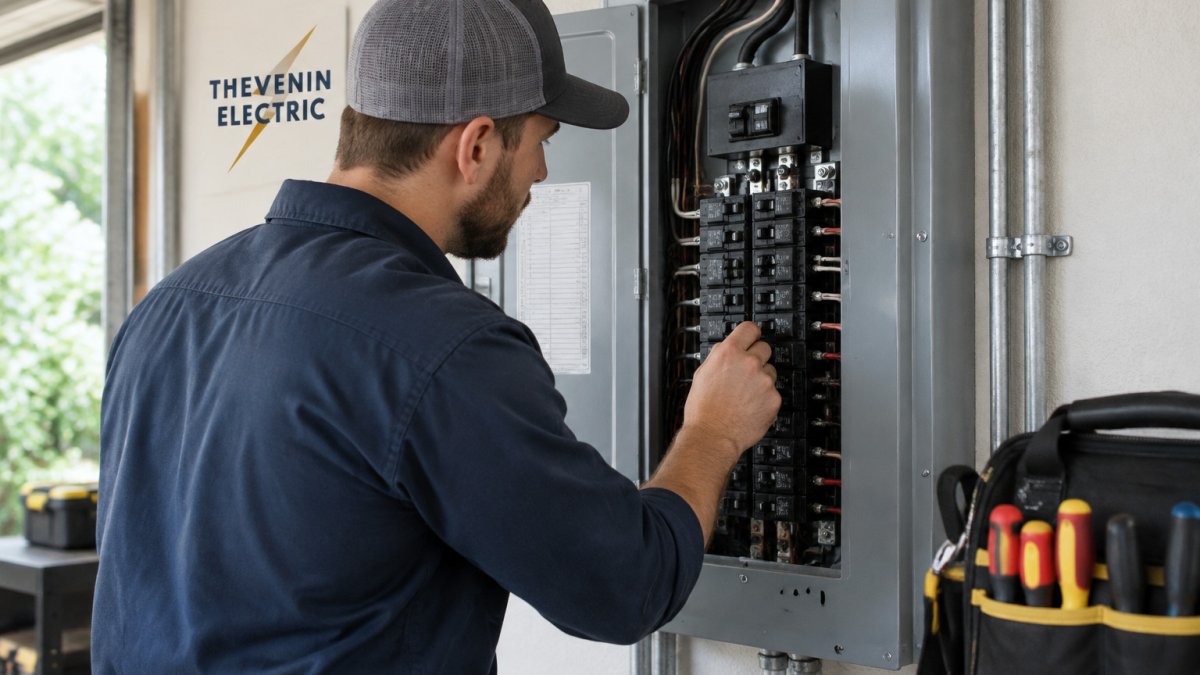
Your electrical panel is the heart of your home's power. In an older house, it may be a fuse box, a split-bus panel, a panel from a brand with a known failure history, or an outdated breaker panel that no longer keeps up with modern demand.

A panel upgrade is often the first of the electrical upgrades worth considering because it gives you a safer, more reliable base for everything else on this list. Electrical panel upgrades are available locally from Thevenin Electric. Our electrical panel upgrade service covers replacement and service upgrades for older homes.
How to Tell What You Have
Before you call anyone, take a look at the panel with the cover closed (never remove the cover yourself). A few visual cues tell you a lot:
Fuse box: Round screw-in fuses or cartridge fuses instead of toggle breakers. These were common through the mid-20th century and often pair with two-wire, ungrounded circuits.
Split-bus panel: Two sets of breakers with no single main disconnect at the top.
Federal Pacific Stab-Lok or Zinsco panels: Breaker brands that have drawn safety concerns. If you see either name, have it evaluated.
Rust, scorching, or a burning smell at the panel: Stop using the affected circuits and get an electrician out promptly.
Hand-labeled circuits that no longer match the house: A sign the panel has been added to piecemeal over decades.
Service Capacity Versus Breaker Space
Two different things often get confused, and the distinction matters for planning.
Service capacity is how much power your home can draw from the utility, measured in amps. A 100-amp service and a 200-amp service deliver very different total power, regardless of how many breakers the panel holds.
Breaker space is how many circuits the panel can physically hold. A panel can have open breaker slots and still lack the capacity for a large new load, and the reverse can also be true: a panel with plenty of capacity but no open slots still can't take a new circuit without changes.
A third factor, branch-circuit requirements, is separate from both. Each new appliance or circuit has its own rules for conductor size, breaker rating, and whether the load is continuous. Those rules don't change just because the panel has room.
Because these factors are separate, check all three before assuming you need a bigger panel. A 100-amp service does not automatically require upgrading to 200 amps; the right answer depends on a load calculation that accounts for what you have now and what you plan to add.
Pro Tip A subpanel adds breaker space and can simplify circuit layout, but it does not increase the service capacity feeding the home. If capacity is the real constraint, a subpanel alone won't solve it.
For a clear walkthrough of checking your own setup, read our homeowner's guide to whether your panel can support an EV charger.
2. Address Outdated Wiring and Grounding
Wiring is the part of your system you cannot see, which makes it easy to overlook and hard to evaluate without opening walls or boxes. Older homes may still contain several generations of wiring layered on top of each other, and each type carries its own concerns.
Recognizing What's Behind the Walls
You can often narrow down what you have without any tools:
Knob-and-tube wiring: Ceramic knobs in the attic or basement, fabric-insulated wires running separately rather than in a cable, and no ground conductor. Common in homes built before the 1940s.
Aluminum branch wiring: Silver-colored conductors at outlets or in the panel, often on 15- and 20-amp circuits in homes built roughly from the mid-1960s through the mid-1970s. Aluminum expands and contracts differently than copper, and connections can loosen over time.
Cloth-insulated or rubber-insulated cable: Fabric-wrapped conductors that become brittle with age. Insulation that crumbles when flexed is a warning sign.
Two-prong outlets with no ground: A strong indicator of ungrounded circuits, though some grounded circuits have been fitted with two-prong receptacles for other reasons.
A mix of wiring types in the same panel: Very common in older homes that have been added to over decades. Mixed systems need careful evaluation, not blanket replacement.
If you see any of these, don't open boxes or panels to investigate further. A licensed electrician can evaluate the condition safely and tell you what actually needs to change.
Why Grounding Matters
A properly grounded system gives fault current a safe path back to the source, which lets breakers and GFCIs do their job. Many older homes have partial grounding, no grounding at all, or grounding that was added inconsistently over the years.
Grounding and bonding are related but not the same. Grounding connects the electrical system to earth; bonding ties metal parts of the system together so they stay at the same potential. Both matter for safety, and both are evaluated as part of a proper inspection.
Rewiring Is a Project, Not a Repair
Full rewiring is a larger project than most homeowners expect. It can involve opening walls, running new cable, replacing devices, and coordinating with other trades. That's why it's worth planning in stages:
Start with an evaluation so you understand the scope before committing to a schedule.
Address the highest-risk areas first, such as circuits feeding kitchens, bathrooms, and any circuit showing heat or arcing signs.
Ask how the electrician will handle wall openings and patching, since that affects both disruption and total scope.
Not every older home needs a full rewire. Sometimes targeted repairs, junction-box corrections, and grounding improvements resolve the actual risk. A good electrician will tell you which situation you're in rather than defaulting to the largest project.
The main wiring types you may find behind an older home's walls, and what each one means:
Wiring type | Typical clue | Key concern |
Knob-and-tube | Ceramic knobs in attic or basement | No ground conductor; common before the 1940s |
Aluminum branch wiring | Silver-colored conductors at outlets or panel | Connections can loosen over time |
Cloth or rubber insulated | Fabric-wrapped conductors | Insulation becomes brittle with age |
Two-prong outlets | No ground hole in receptacle | Often indicates ungrounded circuits |
3. Add GFCI and AFCI Protection Where It Counts
Two types of protection are worth knowing about:
GFCI (ground-fault circuit interrupter): Shuts power off quickly if current leaks where it should not, such as near water.
AFCI (arc-fault circuit interrupter): Detects dangerous arcing in wiring and cuts power to reduce fire risk.
GFCI protection is most important in kitchens, bathrooms, garages, laundry areas and outdoors. AFCI protection is commonly required for many living-area circuits under current code. Which locations apply depends on your home's age, the work being done and the code in effect, so have a licensed electrician confirm the requirements for your project.
4. Upgrade to LED Lighting Throughout the House
Lighting is one of the simplest upgrades to make in an older home. LED fixtures use far less energy than older incandescent or fluorescent lights, and they run cooler, which reduces stress on fixtures and wiring.
Upgrading can also reveal problems. Old fixtures sometimes hide loose connections or undersized wiring. Our lighting upgrade service covers LED lighting work in homes.
Thevenin Electric is an Energy Trust of Oregon Trade Ally. Rebate eligibility depends on the specific product and project, so confirm with the Energy Trust of Oregon before you assume a rebate applies.
5. Plan for an EV Charger or Major Appliances
Modern life adds load. An EV charger, electric range, heat pump, or hot tub can each draw significant power. Before adding any of them, check whether your panel and service can handle the extra demand.
Lower-amperage charging and approved energy management systems can sometimes avoid the need for a full service upgrade. That is why a load evaluation matters more than a guess. If you are interested in charging at home, our EV charger installation service is a good place to start the conversation.
Planning Your Upgrades, Permits, and Next Step With Thevenin Electric
Plan your upgrades in a logical order. Start with safety items like panel condition, grounding and protection devices. Then address lighting and new loads like EV chargers. Sequencing this way keeps you from paying twice for the same work.
Permits and inspections vary by project. Oregon rules depend on the scope of work, so do not assume every job follows the same process. A licensed electrician can tell you what applies to your home.
Costs depend on the scope of work, the equipment chosen, permitting, and any additional repairs found along the way. You can review pricing information on the Thevenin Electric website or request a quote for a clearly defined scope.
Thevenin Electric is a family-owned, licensed, bonded and insured company. You work directly with the licensed electrician on your project. When you are ready, request a quote or call us at (541) 250-3503.
Frequently Asked Questions
How much does it cost to upgrade the electrical in a house?
Costs depend on the scope of work, including whether the panel, service entrance, wiring, and grounding all need attention, how accessible the wiring is, and whether permits and inspections are required. Costs vary with the scope of each project, so the best way to get a number that fits your situation is to request a quote through the company's website or by calling (541) 250-3503.
How can I tell if an older home needs rewiring?
Common warning signs include fuse box or two-prong outlets with no ground, cloth or rubber-insulated wiring, flickering or dimming lights when appliances start, breakers that trip often, warm outlet covers, and burning smells. Some of these have simple explanations, but any of them is a reason to have a licensed electrician evaluate the system. A visual inspection and testing can determine whether the wiring is damaged or simply due for an upgrade.
Do electrical upgrades in Oregon require a permit?
Many electrical upgrades, including panel replacements and new circuits, typically require a permit and inspection, but whether a specific job does depends on its scope and the local jurisdiction. Your licensed electrician can confirm which permits and inspections apply to your project before work begins.
Can an older home support an EV charger and modern appliances?
Often, yes, but it depends on the existing service capacity, the panel's available breaker space, and your household's electrical load. Lower-amperage charging and approved energy management systems can sometimes allow an EV charger without a full service upgrade. A load evaluation is the reliable way to find out what your home can handle.
Comments